Sales operations
Clear Wholesale Pricing and Pack Quantities for B2B Buyers
Help B2B buyers understand exactly what they are ordering. Define selling units, case contents, minimum quantities, and volume prices, then test that the same meaning reaches fulfillment.
October 6, 2026 by nojan
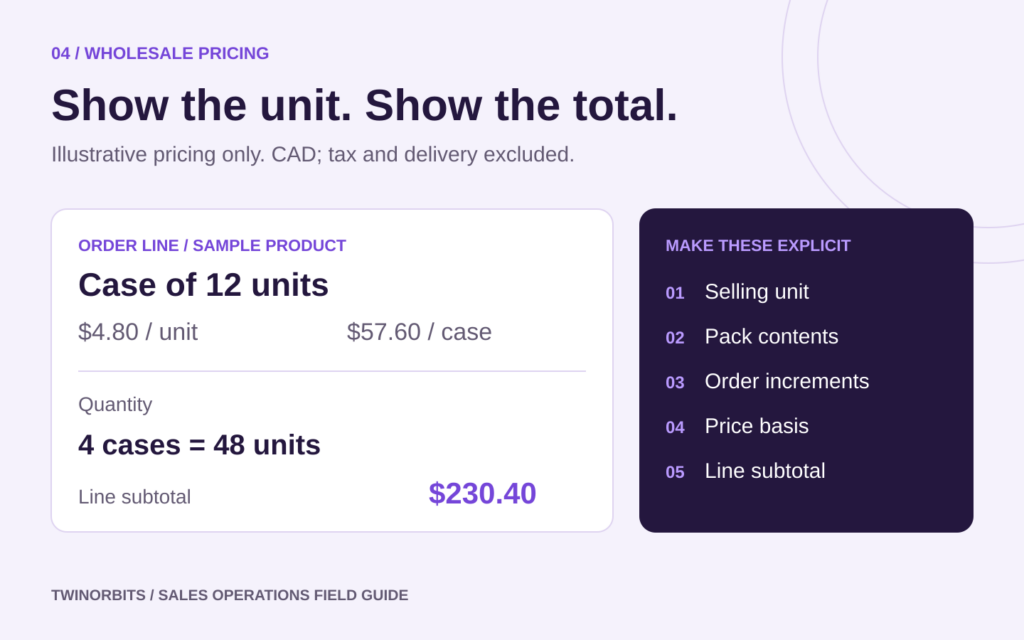
A wholesale price is only useful when the buyer knows what it buys. “48 at $4.80” can mean 48 individual items, 48 packs, or 48 cases. If the sales quote, online cart, and order system interpret that line differently, someone must resolve the mistake before fulfillment.
Sales managers can prevent much of this confusion by agreeing on a clear pricing and quantity format. Show the selling unit, contents per pack, minimum quantity, order increment, and applicable price together. Then verify that the same meaning survives the journey from quote to invoice.
Define the quantities before discussing the price
Use these terms consistently in your product records and customer-facing material:
- Base unit: the individual item used to count the product, such as one bottle.
- Selling unit: what the buyer selects and orders, such as one case.
- Pack quantity: how many base units the selling unit contains, such as 12 bottles per case.
- Minimum order quantity: the smallest permitted purchase for the stated product or variant.
- Order increment: the step by which a valid quantity increases.
- Price basis: whether the displayed amount is per base unit, pack, case, or another defined measure.
Make the scope explicit. A minimum per SKU differs from a minimum across an entire order. A mixed case needs its own definition of contents and permitted combinations.
These are separate settings in commerce systems. Shopify’s B2B documentation, for example, distinguishes quantity increments and minimum or maximum quantities from volume price breaks. Its documented variant-level rules also show why teams should verify whether different colors or sizes can count toward the same threshold.
Show a complete purchasing example
The following fictional example illustrates a pricing format. These are not TwinOrbits product prices or a customer case study.
Illustrative example: a case of 12 bottles
- Product: reusable bottle, blue, SKU BOT-BL-12
- Selling unit: case
- Case contents: 12 bottles
- Minimum: 2 cases, equivalent to 24 bottles
- Order increment: 1 case, equivalent to 12 bottles
- Standard price: CAD 57.60 per case, equivalent to CAD 4.80 per bottle
- Example order: 4 cases × CAD 57.60 = CAD 230.40 for 48 bottles, before tax and shipping
Label the quantity field “Cases” and show the bottle total beside it. The buyer can then connect the order quantity to shelf space and expected demand without doing the conversion from memory.
If your store instead accepts quantities in bottles, explain that valid quantities start at 24 and increase by 12. Entering 48 bottles should produce the same four-case order. Choose one input convention and keep it consistent.
Explain what changes at a volume price break
A lower displayed price creates another question: which quantity qualifies, and which units receive that price?
For the fictional bottle product, suppose an order of 10 cases or more receives an all-units price of CAD 54.00 per case. Ten cases contain 120 bottles and cost CAD 540.00 before tax and shipping. The equivalent bottle price is CAD 4.50.
State that the lower price applies to every case on the qualifying line. If your policy uses graduated pricing, where different portions of the quantity receive different rates, show that calculation instead. Avoid a “from” price without the qualifying quantity beside it.
Also explain whether thresholds apply per variant, product family, order, or purchasing period. Do not leave representatives to decide whether different items can be combined during a customer call.
Give the sales team a clear price decision path
Customer agreements, price lists, volume breaks, and promotions can overlap. Document how your business resolves those overlaps, including whether discounts combine.
A useful internal pricing record includes the customer or group, eligible items, currency, selling unit, effective dates, quantity thresholds, exclusions, and approval owner. Link the approved agreement or price-list version so representatives can verify the terms.
Set a clear route for exceptions. For example, a request to buy half a case might need warehouse approval and a revised quote. Do not promise an exception before checking whether picking, packaging, and the order system can support it.
On a quote, distinguish confirmed charges from estimates. Show the currency, product subtotal, treatment of tax and freight, and any genuine validity date. Describe payment and delivery terms using the approved customer agreement.
Test the whole order journey
Correct product-page wording is only the beginning. Test that quotes, carts, order confirmations, warehouse records, and invoices carry the same quantity and price meaning.
Use a small set of deliberate test orders:
- The minimum valid purchase
- A quantity below the minimum
- A quantity between valid increments
- The valid quantities immediately below and at a price break
- Two variants that may have different rules
- A customer with an approved contract price
- A repeat order after a pack size or price has changed
For each test, check the selected quantity, base-unit total, unit label, applied price, and line subtotal. Ask operations to confirm the expected pick quantity as well.
The Sprinkle Commerce guide includes validating pricing tiers, minimum-order and volume rules, and customer pricing visibility. It also recommends testing a quote or contract request through approval and order conversion. Use that as a starting point when reviewing a Sprinkle setup, with your actual selling units and agreements.
Wholesale pricing checklist
- Every price names its currency and selling unit.
- Pack contents, minimums, and increments are visible together.
- Volume thresholds and eligible items are unambiguous.
- Customer-specific terms have an approved source and owner.
- Invalid quantities receive a clear correction message.
- Sales and operations agree on the resulting pick quantity.
Frequently asked questions
Is the minimum order quantity the same as the pack size?
They can differ. A case may contain 12 items while the minimum purchase is two cases. Show both values and their units.
Should we display a per-item price when selling by the case?
A per-item equivalent can help comparison, provided the case price and required purchase are equally clear. Keep the order control labeled with the actual selling unit.
Review your pricing and ordering flow
Choose three products that regularly generate quantity or pricing questions. Bring anonymized price lists, sample quotes, and pack definitions to a TwinOrbits discovery call to discuss how your commerce and operational systems should handle them consistently.