Sales operations
How to Organize B2B Follow-Up Without Repetitive Messages
Organize B2B follow-up around a clear next action, an accountable owner, and the buyer’s timing. Use this practical workflow to improve handoffs and avoid repetitive messages.
October 6, 2026 by nojan
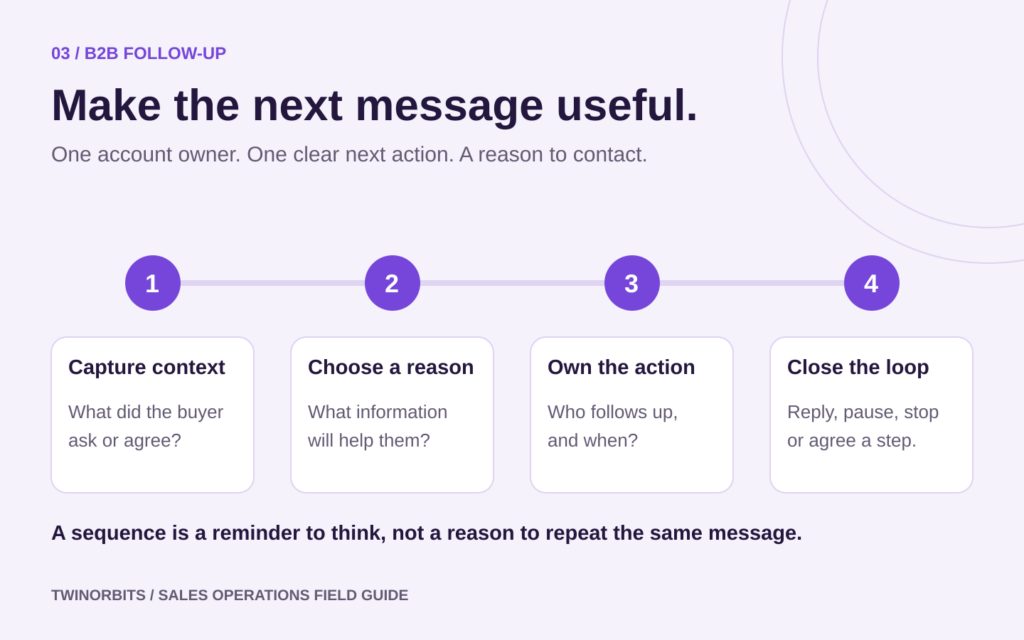
Good B2B follow-up gives a buyer a useful next step and gives the sales team a reliable record of what happens next. When those two things are missing, representatives send similar reminders, managers chase updates, and customers receive messages that ignore their last conversation.
Start with a shared process for active opportunities: one accountable owner, a specific next action, a due date, and a reason to contact the buyer. Then automate the parts that are predictable. This guide shows sales managers how to organize that process without filling inboxes with repetitive messages.
Give every follow-up a purpose
Before writing a message, identify the decision or task it should help complete. A buyer reviewing a specification needs different information from a buyer waiting for purchasing approval.
Use a small set of practical follow-up categories:
- Clarify: resolve a missing requirement, quantity, delivery location, or technical question.
- Confirm: check an agreed action, such as reviewing a sample or sharing a purchasing timeline.
- Enable: provide something the buyer needs, such as a revised quote or product comparison.
- Schedule: agree when to continue a conversation that has a known future trigger.
- Close: establish whether the opportunity should remain active.
If a representative cannot name the purpose, review the opportunity before sending another reminder. The useful next action may be an internal stock check rather than a customer email.
Keep a minimum follow-up record
Define the information your team must update after each meaningful interaction. A CRM is a suitable home, but the same discipline can begin in a shared tracker.
- Account, contact, and related opportunity or quote
- One accountable owner and a backup for absences
- Last meaningful interaction and what the buyer said
- Current blocker or decision still needed
- Next action, including who must take it
- Due date or agreed event that triggers the action
- Preferred contact channel and relevant communication restrictions
- Status: active, waiting internally, waiting for buyer, deferred, or closed
Write actions as something a person can complete. “Follow up” leaves the next representative guessing. “Send the revised carton quantities after operations confirms availability” explains the dependency and the deliverable.
Keep the source message or quote linked to the record. A short summary helps people scan; the original context helps them resolve uncertainty.
Build the cadence around the buying process
Set the next contact date with the buyer whenever possible. If they expect a committee decision next Thursday, use that timing. A generic two-day reminder adds little when the decision cannot happen yet.
When no timing is agreed, create a modest, finite sequence appropriate to the relationship. Decide what each step contributes, how the team will handle silence, and when the sequence ends. Treat the first version as a process to review rather than a universal formula.
Illustrative example: following up on a wholesale quote
The following is a fictional example, not a TwinOrbits customer case study.
- After the quote discussion: send the requested quote and confirm the outstanding decision. “The revised quote includes the two delivery options we discussed. Which location should we use for the order?”
- On the agreed review date: ask about the known dependency. “You mentioned purchasing would review the quote today. Do they need the pack-size breakdown before making a decision?”
- If the date passes without a response: offer a clear way forward. “Would it help to revise the quantities, or should we revisit this after your inventory review?”
- If there is still no response: close the immediate loop. “I’ll leave this quote inactive for now. If the requirement returns, we can confirm current pricing and availability.”
Adapt these messages to real facts. Do not invent a deadline, claim stock is reserved, or imply the buyer promised an action they never agreed to.
Automate reminders with clear stop conditions
Automation can create tasks, flag overdue actions, and send approved messages for well-defined situations. Human review is valuable when a buyer raises an objection, changes scope, disputes a price, or has a service problem.
Configure and test what should pause or end each sequence: a reply, a meeting, an order, an opt-out, a bounced address, a closed opportunity, or a change of owner. Also check whether another colleague is already speaking with the same account.
These controls vary by system. For example, HubSpot documents configurable reply and meeting unenrollment triggers, including contact-level and company-level options. Its documentation also describes limitations in detecting out-of-office replies. Test your own configuration instead of assuming every response stops future messages.
A paused sequence still needs an owner. Route the reply into a visible work queue so an automated stop does not become a forgotten conversation.
Review the exceptions each week
A short management review should focus on records that need a decision. Start with overdue commitments, active opportunities without a next action, internal blockers, and accounts receiving overlapping outreach.
Measure whether the process is helping buyers move forward. Useful measures include the proportion of active opportunities with a dated next action, overdue actions by owner, and replies that lead to an agreed next step. Review message quality alongside the counts.
Follow-up checklist for sales managers
- Every active opportunity has one accountable owner.
- The next action addresses a known decision or blocker.
- Timing reflects the buyer’s stated process where available.
- Each message adds context, an answer, or a useful choice.
- Stop conditions and handoffs have been tested.
- Deferred and closed opportunities have an accurate status.
Frequently asked questions
How many B2B follow-ups should we send?
Use the buyer’s timing, the existing relationship, and the value of each message to set a finite plan. There is no single count that suits every opportunity. Respect requests to stop and avoid continuing a sequence without a useful reason.
Should follow-up always be automated?
Automate predictable reminders and task creation first. Keep judgment-heavy conversations with an accountable person, and verify the handoff between automated steps and manual work.
Make your follow-up process easier to run
Review customer service optimization when enquiry ownership and handoffs are part of the problem. Bring an anonymized quote journey, your current CRM stages, and two examples of follow-up that went wrong to a TwinOrbits discovery call. We can discuss where clearer ownership, connected records, and workflow changes would help your team.